
Ask Jimmy
A Story in Two Temperatures
By the time I realized I was looking for Jimmy, he had been missing for decades.
Nobody had filed a report.
The Sun contained enough electrons to outnumber every grain of sand on Earth by a margin too large to picture and too ridiculous to ignore. Nobody bothered to give any of them names. Losing one wasn’t a crime. It wasn’t even an accounting error.
A single electron was unimportant. That turned out to be the problem.
I just didn’t know that yet.
• • •
At one in the morning, I thought my problem was an argument. At nine, I was due before the Joint Observing Committee to appeal its decision to leave Radio out of the next quiet-Sun campaign. The next suitable window would not come for three years. They had already said no. Maya called in a favor and got me, of all people, twelve minutes to change its mind. She would not tell me what it had cost her.
The committee’s position was simple. For decades, the instruments they trusted had told versions of the same story. Radio had returned two temperatures and could not even agree with itself.
Radio was not invited.
The first slide of my appeal said:
WHY IS THE CORONA SO HOT?
Underneath was a photograph taken during an eclipse. The black disk of the Moon covered the Sun, and the corona streamed around it in white veils.
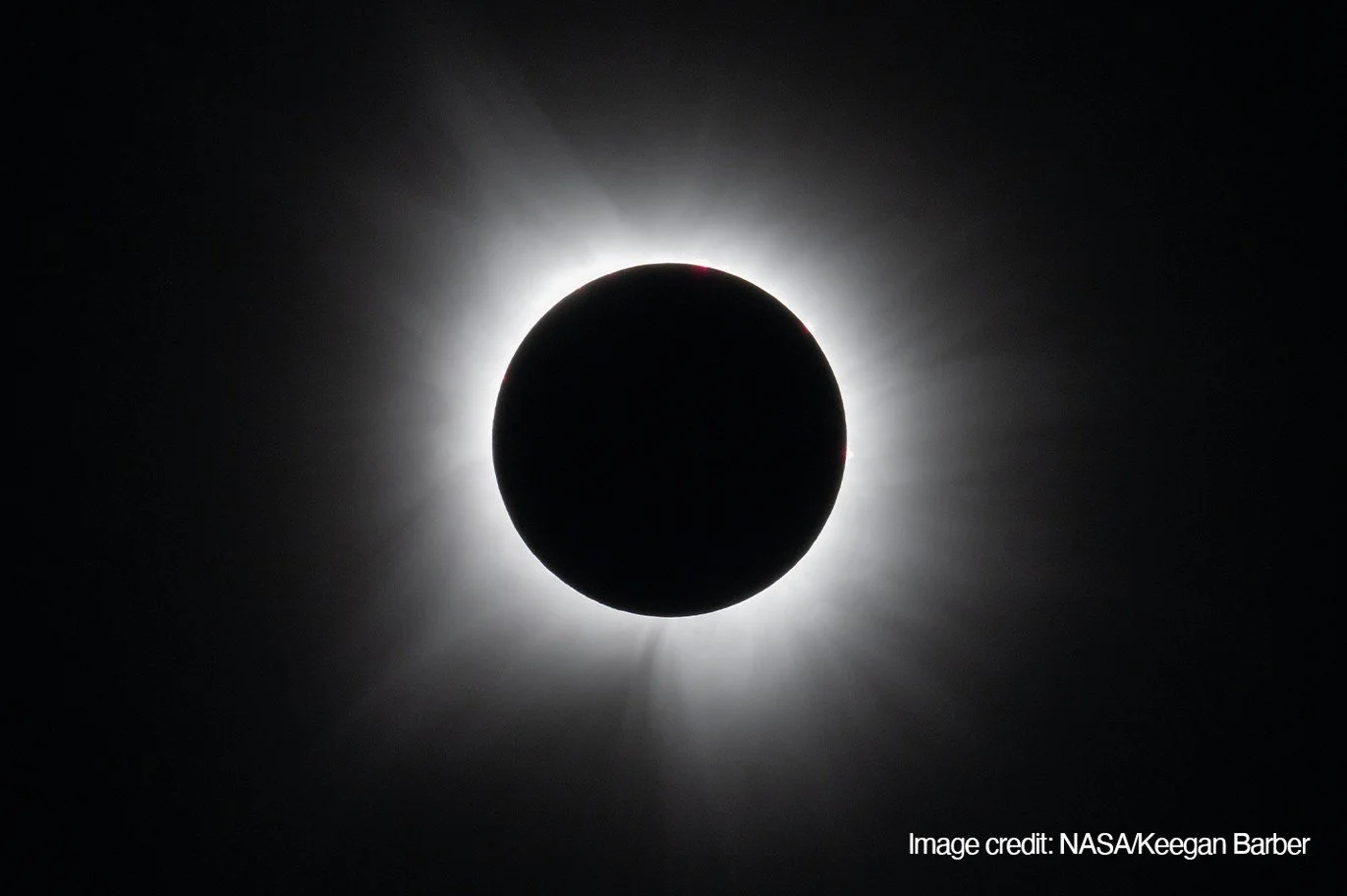
The committee would like the photograph. Everybody likes the photograph.
The second slide was where the trouble started.
620,000 degrees
1,500,000 degrees
Same quiet corona. Same long radio record. Two answers, separated by almost nine hundred thousand degrees.
At one-fifteen in the morning, I deleted the smaller one.
At one-seventeen, I put it back.
At one-twenty, Maya came into my office carrying two coffees and the expression she normally reserved for public debates.
“You’re still here.”
“So are you.”
“I came back for my keys. Decided to take a detour on the way back.” She placed one coffee beside my keyboard. “You appear to have kidnapped the Sun.”
The case covered most of the wall. Radio images. Density profiles. Spectral lines. Atomic rates. Equations from me and equations written by people who had died before I could read. Red thread would have been excessive, so I had used blue.
Maya read the two numbers on the monitor.
“Which one are you deleting?”
“The smaller.”
“Why?”
“It has no friends.”
“That is sociology.”
“It’s a proposal.”
She took my chair. I sat on the radiator.
Maya was a kinetic theorist. Her corner of physics had spent decades arguing that a small population could change the answer. It had made her professionally tolerant of outliers, including colleagues.
“I got you a hearing,” she said. “I did not get you permission to lie efficiently.”
“The committee wants one question, one prediction, and one reason to let Radio into the campaign.”
“Then give them those.”
“They have twenty years of EUV work on the other side.”
“They have numbers.”
“Strength in numbers.”
“To the zeroth power,” she said. “You still get one perspective.”
She pointed at the two temperatures. “Start again. No slides.”
So I started with the witness nobody wanted.
• • •
Radio had been watching the quiet Sun for eight years.
Quiet meant no major flare or active region. It did not mean nothing was happening.
Not continuously. The Sun is rarely quiet on command. But on 183 days between 2004 and 2011, it had been quiet enough. Six frequencies with hundreds of images. And one pale atmosphere changing size depending on how Radio looked at it.
“What did you see?” I asked Radio.
“A crowd.”
“What kind of crowd?”
“Electrons.”
“I know that.”
“Then why did you ask?”
I sighed. Instruments become difficult when they know you need them.
Radio slid its first statement across the table.
620,000 degrees.
At those wavelengths, Radio could not see through the corona. It saw a glowing surface, the way we see the face of a fog bank instead of every droplet inside it. Most of that glow came from the slower, more crowded electrons.
When that was translated into a temperature, it said: 620,000 degrees.
“Too low,” I said. “The textbooks put the quiet corona above a million.”
“Then go interview the textbook.”
“Calm down. Could scattering have made the source look bigger and cooler?”
“Not by enough.”
“Calibration?”
“For eight years?”
“A bad model of the atmosphere?”
Radio said nothing.
Silence from an instrument isn’t agreement. It’s just a request for a better question.
Back in the office, Maya was still in my chair.
“The low number stays,” I said. “It isn’t one bad point.”
“So you cannot delete it because it is inconvenient.”
“I could delete it because it measures the wrong thing.”
Maya looked at me over the rim of her cup. “What thing does it measure?”
“Temperature.”
“That is its answer. I asked what it measures.”
On the wall behind her, the eclipse corona streamed outward in white loops. It took me a moment to notice she had used my interrogation against me.
“Fine,” I said. “I’ll ask again.”
• • •
Radio’s second statement came from the same record.
The corona is the Sun’s atmosphere. Like Earth’s atmosphere, it gets thinner the higher you go. Heat changes how quickly. A cooler crowd stays packed close to the Sun. A more energetic crowd spreads farther out. Different radio frequencies let Radio look at different heights, so it could see how far the crowd had spread. The electrons were not doing all the work. Heavier particles called ions carried some of the energy too. After allowing for their share, Radio’s second answer was:
1,500,000 degrees.
“You realize this is worse,” I told Radio.
“Only if both answers came from the same question.”
I stopped.
Radio had never claimed they did. I had.
Radio’s first answer was influenced most by the slower electrons, which made up most of the crowd. Its second answer came from how far the atmosphere spread above the Sun. In an ordinary electron crowd, slow and fast electrons appear in a predictable balance. Both answers should have pointed to the same temperature.
They did not.
On the board I wrote:
WHICH ONE IS WRONG?
Maya read it.
“You have asked that already.”
“And yet, it remains a good question.”
“It remains the question you prefer.” She pointed at the smaller number, then the larger. “Who in the crowd speaks loudest to each measurement?”
An electron does not have a temperature by itself. Temperature belongs to a crowd, and a number is what remains after a measurement has ignored almost everyone in it.
I crossed out the question.
Underneath I wrote:
WHAT DID THEY ENCOUNTER?
Maya gave the smallest nod she could muster.
The low number had survived. My original appeal had not.
It was nearly two in the morning.
We had seven hours left.
• • •
The committee’s case against Radio was built mostly from iron—not solid iron, but electrically charged iron atoms mixed through the corona.
Scientists had spent decades studying the precise colors of light those ions produced. They called them spectral lines. Iron did not come alone. It arrived with rows of those lines, years of observing programs, calibration meetings, and papers that cited other papers until the citations looked like a second atmosphere.
Far more time had been spent collecting this kind of evidence than the radio evidence. Every new line looked like another vote. The iron ions sat inside the electron crowd. Most electrons passed without leaving a mark.
But an electron carrying enough energy could strike an ion and leave it briefly holding extra energy. When the ion settled again, it released that energy as light.
“Tell me about the fast ones,” I said.
Iron showed me two bright lines.
“How many were there?”
“Enough to leave this.”
“That isn’t a number.”
“It’s what happened.”
Iron’s evidence pointed, but it did not prove. A small error in the measured brightness of either line could change the comparison. Worse, the telescope looked through several layers of corona at once. Their light arrived mixed together. Several ordinary crowds at different temperatures could produce the same pattern as one unusual crowd containing extra fast electrons. Read one way, the lines pointed toward the fast ones. Read another, several ordinary crowds had left the same marks.
“So you can’t identify the fast ones,” I said.
“I can tell you someone hit me.”
Back in the office, Maya had moved from my chair to the floor. Papers surrounded her in a semicircle.
“Iron won’t identify the fast electrons,” I said.
“The lines point, but they do not identify.”
“The committee calls those lines convergence.”
“They are honest measurements.”
“So is Radio.”
“Exactly.”
I looked at her.
“Many related answers are not the same as different questions,” she said.
“That distinction is going to consume all twelve minutes.”
“Then tell a shorter truth.”
On the board, I wrote what each measurement had encountered.
Radio brightness: the crowded core.
Radio scale height: the pressure carried by the broader population, after the ions had taken their share.
Iron lines: the energetic collisions.
We had filed all three beneath the same word:
TEMPERATURE.
Under the ordinary model, the answers should have lined up. They didn’t.
The same possibility kept returning: electrons too few to dominate the glow, yet energetic enough to change what Iron reported.
I picked up the marker.
“Don’t,” Maya said.
“I haven’t done anything.”
“You’re about to name them.”
“Just one.”
“It doesn’t need a name. It needs a function.”
“The committee will remember a name.”
“That is not always an argument in favor.”
Between 620,000 and 1,500,000, I wrote:
JIMMY
Maya stared at the board, then at me.
“You’re serious.”
“Completely.”
“You’re calling the entire suprathermal tail—the unusually fast end of the crowd—Jimmy.”
“Not the entire tail. Just Jimmy.”
“One electron you could never possibly identify.”
“Exactly! He’s missing.”
For the first time that night, Maya laughed.
“Jimmy Electron.”
“No, just Jimmy.”
She stopped laughing first.
“Jimmy isn’t new,” she said. “People have been making versions of this argument for decades.”
“I know.”
“Then what are you claiming?”
I looked from the radio record to the iron lines. They came from archives that overlapped in subject and almost nothing else. Different days. Different fields of view. Different pieces of quiet Sun.
“That nobody has put the disagreement in the same room.”
Maya followed my eyes around the wall.
“Okay,” she said. “Now you may have a case.”
I was still looking at Jimmy.
Without thinking, I drew a line beneath his name. It rose, curved, and disappeared over the other side.
Maya watched me.
“What is that?”
“A hill.”
“Why is Jimmy at the bottom of a hill?”
“I want to know if he can make it over.”
“Oh my God. You’re empathizing with an electron.”
“No. I’m investigating.”
“Jimmy does not have feelings.”
“He has momentum.”
She handed me my coffee. It had gone cold.
“Six hours,” she said.
“Until the committee?”
“Until your missing electron and his little mountain become a test.”
At the door, she looked back.
“I’m going to see whether the equations permit this nonsense. If Mount Jimmy is still in that presentation at nine, I will deny knowing you.”
Then she left me alone with the Sun.
• • •
Maya had meant the hill as an accusation.
I took it as a method.
The hill wasn’t a place. It was everything that made the trip from the crowded lower atmosphere into the thin corona difficult, reduced to a line I could draw.
Down in the crowded lower atmosphere, Jimmy could barely move without a collision changing him. Most electrons that started upward lost speed, turned, or vanished back into the crowd.
Jimmy was already fast.
He climbed. The slower electrons fell away behind him. The crowd thinned, the distance between collisions grew, and eventually he crossed.
Nothing had heated him at the summit. The hill had simply refused to admit slower electrons. Scientists had a name for one version of this: velocity filtration.
It was physically allowed. The data had not demonstrated it.
Above the hill, electrons like Jimmy made up more of the remaining crowd. A measurement sensitive to the crowded core could nearly overlook them. A line excited by energetic collisions would weigh them more heavily.
That was how Jimmy could have gone missing without disappearing.
I followed him farther. In the thinner corona, collisions came farther apart. For the first time, “where an electron had come from” could matter. It carried a history that neither Radio nor Iron could reconstruct after the fact.
That was the flaw in the archives. The instruments had not contradicted one another in the same room. They had testified from different scenes.
At five-thirty, I pulled the observing logs from the wall. The dates missed. The fields of view missed. Even “quiet Sun” covered more territory than our comparison admitted.
I opened a new slide.
SAME PLACE. SAME TIME. DIFFERENT QUESTIONS.
One instrument would watch the crowded core. The other would listen for the energetic collisions. Neither would be allowed to substitute a nearby day, a nearby region, or an answer inherited from somebody else.
At seven-forty, Maya returned with a paper bag under one arm and three equations covering half a page in her hand.
She stopped in the doorway. By then, the hill crossed half the wall, and Jimmy stood near the top as a circle with a minus sign inside it.
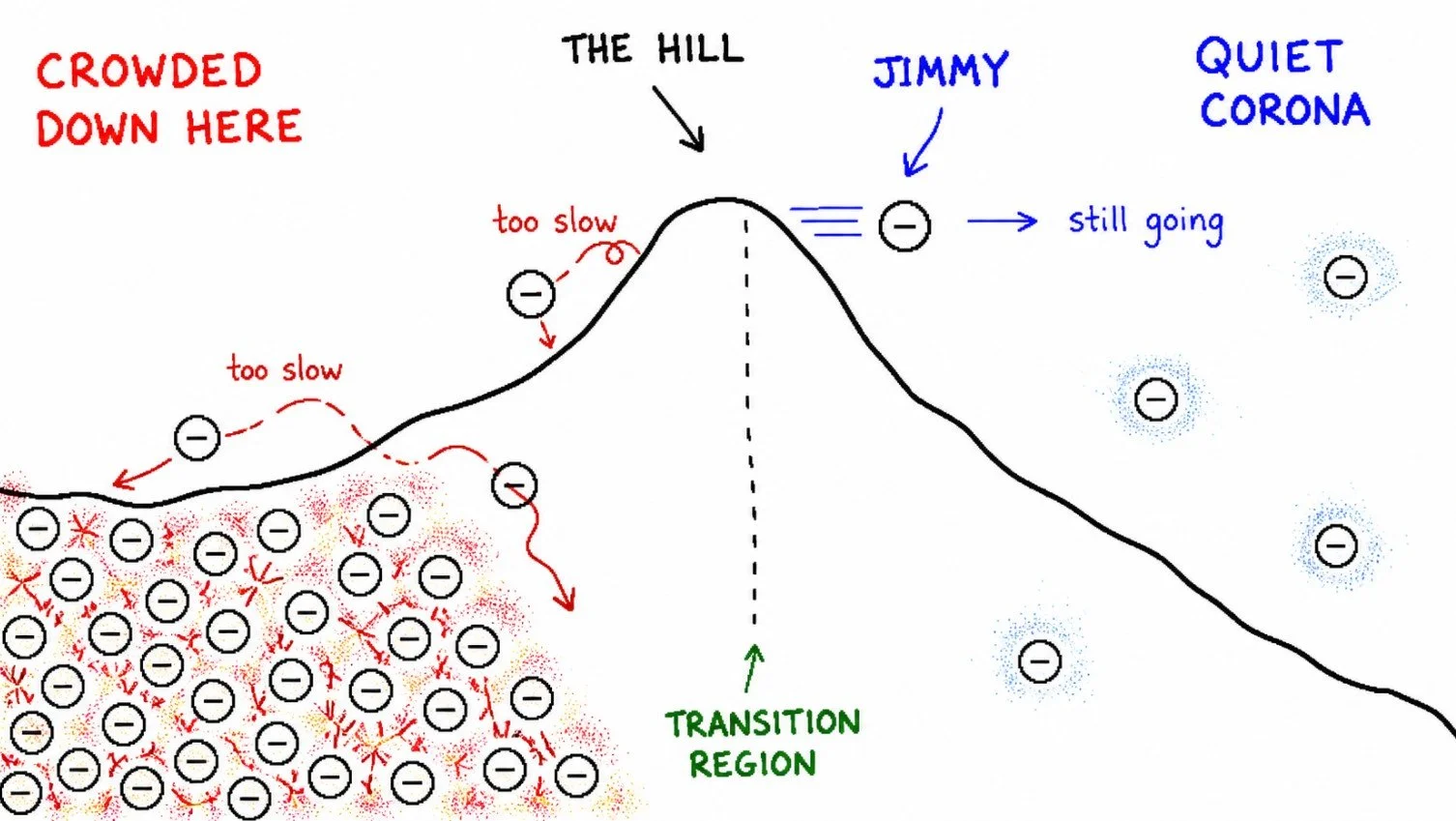
Mount Jimmy: the ridiculous picture that led to a rigorous question.
“You gave him a body.”
“That is an electric charge.”
“You’ve been alone too long.”
She put the bag on the desk and studied the wall.
“What happened to him?”
“He made it over.”
“How?”
“He was already moving fast enough.”
“And the others?”
“Most of them weren’t.”
“So nothing heated him at the top.”
“Not in this version.”
“Good.”
“You agree?”
“I said it is physically allowed. Don’t push it.”
She laid her page beside the keyboard. The equations followed how collisions treated electrons at different speeds. Near the bottom, she had circled the place where the fast ones traveled farther before the crowd rewrote them.
Beside the circle she had written:
SAME PLASMA. SAME TIME.
I turned the monitor toward her.
She read my slide. I read her page.
“First of all, your hill is offensive,” she said.
“…buuuut?”
“But it led you to the same observation.”
“Mount Jimmy has been validated.”
“The question has been validated. The mountain remains a professional embarrassment.”
“Can we prove Jimmy came over the hill?”
“No.”
“Can we ask?”
Maya looked at the slide again.
“Now we can.”
She advanced to the first slide.
WHY IS THE CORONA SO HOT?
“Does Jimmy answer this?” she asked.
“No.”
“Does velocity filtration?”
“Not from the evidence we have.”
“Then what do you promise the committee?”
I looked at the two temperatures. For once, I did not reach for the eraser.
“A fair disagreement.”
Maya took a pastry from the bag.
“There,” she said. “That is your hearing.”
• • •
At nine-oh-three, seven committee members sat on one side of a long table while Maya and I sat on the other. Radio and I had both reached the room on her name.
Our allotted twelve minutes glowed red on a screen behind them.
12:00.
I opened the first slide. The eclipse appeared.
WHY IS THE CORONA SO HOT?
I had rehearsed the next sentence for two weeks but I didn’t say it.
Instead, I picked up the marker beside the display.
“This is the question we inherited,” I said.
Underneath it, I wrote:
620,000 K
1,500,000 K
The chair looked from the numbers to me.
“Which one?”
“Possibly both.”
Nobody wrote anything.
The timer began to fall.
I told them what the measurements had encountered. Radio brightness listened hardest to the crowded core. The radio scale height read the pressure of the broader population. The iron lines responded to energetic collisions. Under the ordinary model, the answers should have converged.
They had not.
One committee member folded his hands. “We have dozens of EUV line measurements supporting the conventional interpretation.”
“You have dozens of EUV numbers,” I said. “That is not the same as a different diagnostic.”
“Are you disputing the lines?”
“No. I’m disputing the vote count.”
The chair glanced at Maya. Maya did not rescue me.
I advanced the slide.
Mount Jimmy appeared.
The chair stared at it.
“Are you serious?” asked the committee member.
“It’s a picture,” Maya said.
I looked at her.
She continued. “The calculation is underneath it. Both say the same thing: fast electrons can travel farther before collisions rewrite them.”
The chair glanced from Maya’s equations to Jimmy.
“Then what does the picture add?”
“It told him what to measure.”
Another committee member pointed at Jimmy. “You are claiming velocity filtration?”
“No,” I said. “The equations say it is allowed. The picture led me to the same next question. Neither tells us whether the electrons took that road.”
“Then you have no mechanism.”
There it was. One clean mechanism would fit on the application. I could give it to them. Maya had even supplied the equations.
The timer showed 06:12.
“Not one I can claim rigorously,” I said.
I advanced to the final slide.
ASK JIMMY: SAME PLACE. SAME TIME. DIFFERENT QUESTIONS.
“The archival instruments saw different scenes,” I said. “This window puts Radio and the EUV diagnostics on the same patch of corona at the same time.”
“What if they agree?” the chair asked.
“Then Jimmy was a bad lead.”
“And if they don’t?”
“Then the discrepancy survives a fair comparison. We will know which part of the electron crowd each diagnostic encountered, and we will have something precise enough to test next.”
The chair closed the proposal.
“We can approve the EUV sequence,” she said. “Radio can be compared with its existing archive.”
For one second, I had the time. All I had to do was leave the inconvenient witness outside.
“Then the instruments will be looking at different scenes again.”
“Radio has eight years of quiet-Sun coverage.”
“Eight years of other scenes.”
“The alternative may be no allocation.”
Maya had spent her favor getting me into the room. The sensible thing was to take what they offered, improve the statistics, and return in three years with a cleaner version of the same disagreement.
“Then I have no use for your six hours,” I said.
The timer showed 04:03.
The chair turned to Maya. “You requested this appeal.”
“I did.”
“Your field has only recently persuaded this committee that these electron distributions deserve observing time.”
“That is why the observation has to be able to fail,” Maya said. “If we exclude the diagnostic that disagrees, we manufacture convergence.”
The room was quiet.
Maya nodded toward Mount Jimmy.
“I am not defending his mechanism. I am defending the comparison.”
The timer reached three minutes.
I had nothing else I trusted enough to say.
So I stopped.
The chair looked at the unused time, then at the final slide.
“Why Jimmy?” they asked.
“Because electrons do not get names,” I said. “It makes them easy to average away.”
“This… Jimmy… is a real electron?”
“No. Jimmy is the one I remember to ask about.”
The chair finally made a note.
“Send us a revised target list by noon,” she said. “The same coordinates and times for both instruments. No substitutions after scheduling.”
I waited for the rest of the sentence.
There wasn’t one.
Maya closed her folder. The hearing was over.
• • •
Outside the conference room, morning sunlight filled the corridor.
“Did we get it?” I asked.
“You heard her.”
“I heard a request for a target list.”
“From this committee, that is practically a declaration of love.”
We walked back toward the office.
“You defended Mount Jimmy.”
“I defended the observation.”
“While pointing at Mount Jimmy,” I teased.
“Do not make me regret this.”
Inside, the case still covered the wall. Radio was there. Iron was there. Maya’s equations were there. So was Mount Jimmy.
At the center, 620,000 and 1,500,000 remained side by side.
For once, I did not reach for the eraser.
Maya did.
She erased WHY IS THE CORONA SO HOT? from the top of the board and rewrote it lower down. She left the space above it blank.
“Question Two?” I asked.
“Maybe.”
“What is Question One?”
She tossed me the marker.
“Ask Jimmy.”