
The Innovation Hangover
Why 2026 is the Year of Maintenance
If the last five years in HR Tech felt like a party (or at least started out as one), then 2026 is the hangover.
For half a decade, the industry has been drunk on Digital Transformation. We bought into the idea that if we just purchased enough modules, implemented enough AI, and followed the “Best Practice” playbook, our organizations would become self-driving vehicles of efficiency.
But look at your dashboard today. Is it cleaner? Is your data more reliable? Or is your team just working harder to keep the lights on?
The reality is that while we were busy buying innovation, we were accumulating entropy. And now, the bill is due.
The Cycle
We didn't get here because of bad actors. Workday® sells a powerful product. Consultants work hard to fill the gaps. Clients genuinely want to modernize.
We got here because of a systemic failure in how we build these systems.
It usually starts with a simple question: What is everyone else doing?
Clients, unsure of their own architecture, ask partners for the standard playbook. Partners, incentivized to deliver on time and on budget, copy-paste the “Best Practice” configuration because there are no requirements (I’m sorry, but “we just want to be compliant” is more prayer than requirement).
It works, technically. The system goes live. The project is marked green.
But “Best Practice” is a generic solution to a specific problem. It ignores the unique friction of your organization's culture. Over time, that friction creates heat. You add a custom rule to fix a gap. You patch an integration to handle an edge case. You turn on a new module because it was part of the bundle.
It’s coasting down the path of least resistance.
But inertia has a cost.
The Rise of Phantom Load
In thermodynamics, entropy is the measure of disorder in a closed system. If you keep adding energy (new features, complexity) without a mechanism to dissipate it (maintenance), the system eventually thermalizes. It stops doing useful work and starts generating heat.
In the electrical world, we call that wasted energy "Phantom Load" (the electricity a device draws even when it appears to be turned off).
In the corporate world, our systems are full of it.
Phantom Load is the manual effort secretly required to prop up the "automated" system. It operates on two main drivers:
1. The Automation Loop We "outsource" tasks to the system (a transfer process, a compensation rule, a workflow, a validation, etc.) thinking we’ve washed our hands of it. But when the system hits an edge case, it doesn’t just stop; it short-circuits. It throws the task back at you with an error message you don’t understand.
Now you aren't just doing the transfer; you’re investigating why it failed and re-learning logic you set up six months ago. You spent an hour building the automation to save ten minutes. Now you're spending two hours debugging it. Then you get to train the next agent (or the next human resource).
2. Defensive Administration When a system is unstable, people stop optimizing and start surviving. This is the biggest source of Phantom Load.
Admins maintain "side spreadsheets" because they don’t trust the eligibility logic.
Managers demand manual approvals because they don’t trust the workflow.
Teams spend half of their energy on CYA activities (saving down email trails, hunting lost files, and practicing arguments for the next meeting) just to prove it wasn’t their fault when the system inevitably glitches.
External parties also assist in this effort, which drains budget for support services.
The cruel irony of the last few years is that in our pursuit of automation, we actually increased the thermal load on our teams. The HR Admin manually correcting retroactive payroll. The Specialist maintaining a shadow database because they don’t trust the data in the tenant. The Manager slacking a recruiter because "self-service" is too confusing. Meanwhile, everyone is pointing fingers — desperate for somebody to blame while increasing the load for the business.
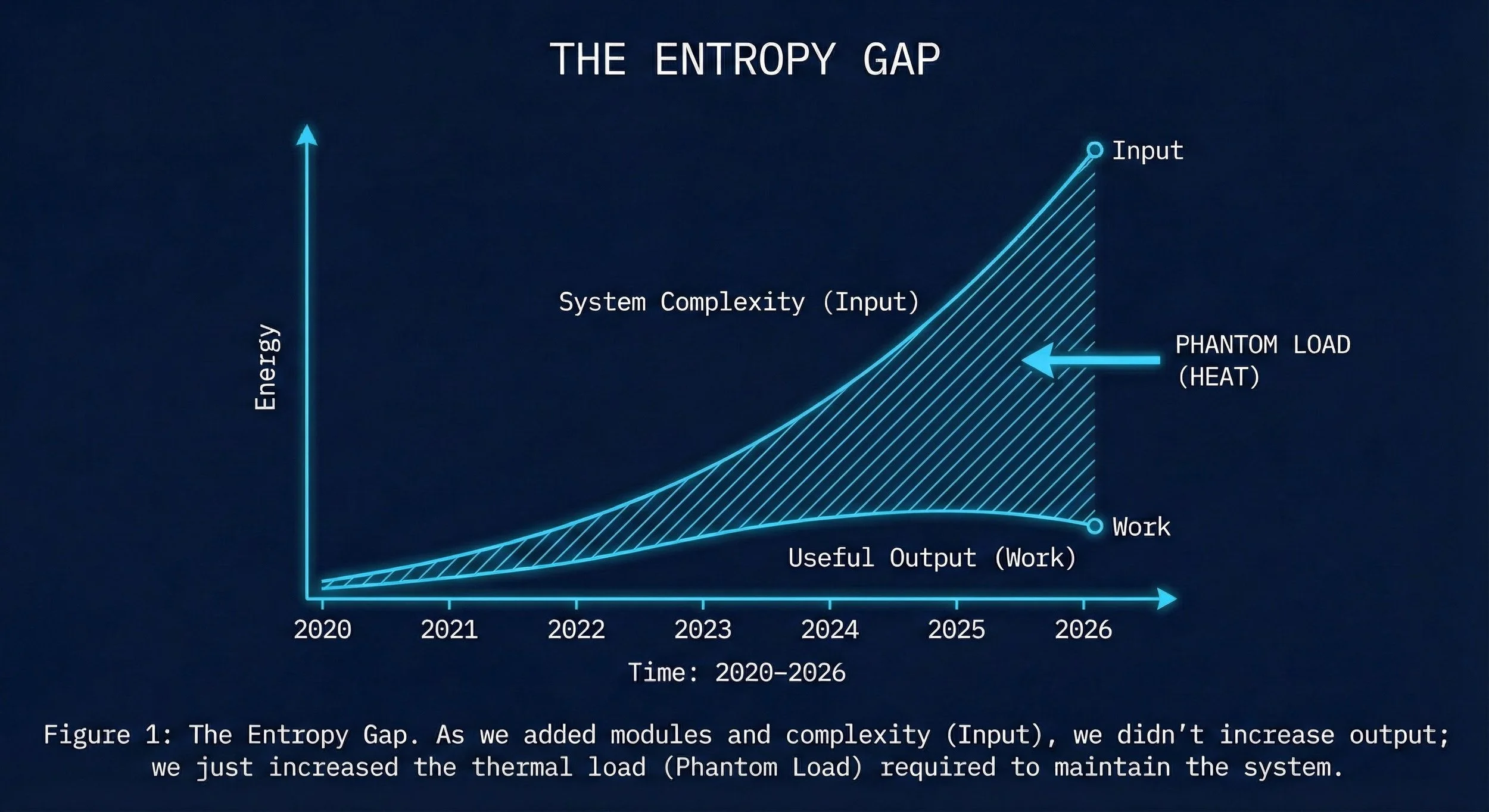
We built systems so complex that they require a human to escort the data from point A to point B.
And that human may no longer work there.
The “Out of Time” Reality
In 2022, I noted that the consulting model was shifting toward staff augmentation. In 2024, I pointed out the gap between AI marketing and data reality. I wasn't guessing; I was watching the entropy build up.
Now, in 2026, we are out of time.
The economic reality has shifted. The budget for “Transformation” is gone. The patience for “Roadmaps” has evaporated. Organizations can no longer afford to carry the debt of broken systems. The Expansion Phase is over.
We have entered the Maintenance Phase.
Maintenance is a discipline. It’s a refusal to add new complexity until the foundation is rock-solid. It is the understanding that a boring, functional payroll run is infinitely more valuable than a broken AI talent marketplace.
The Final Word: Operational Reality
This is why I am pivoting Final Stop Consulting.
I am done talking about the “Future of Work.” I am focused entirely on the Operational Reality of today.
I am not here to sell you a vision, and I am not here to implement some generic playbook. I am going back to the floor. I am acting as the mechanic for organizations that are ready to stop expanding and start stabilizing.
We aren't doing "Digital Transformation." We are doing Integration Remediation.
We aren't doing "Strategic Roadmapping." We are doing current process design.
We aren't doing "Best Practice." We are doing the best thing that actually works for your specific tenant.
The era of fake innovation is over. It was a fun party, but it’s time to clean up the mess.
The lab is closed. The shop is open.